A Simple Plan for Every Homeschool Day
One of the greatest blessings of homeschooling is its freedom.
When families first begin homeschooling, they often ask, "What should our timetable look like?" It is a perfectly natural question. After all, most of us have spent our entire lives following someone else's timetable. We instinctively assume that a successful education requires every hour of every day to be carefully planned.
Homeschooling invites us to think differently.
Your education should fit around your family, not your family around an educational system.
One family may work best early in the morning. Another may not begin until after lunch. Some families prefer to complete their work over four longer days and keep Friday free. Others are happy to spread their learning across six days, enjoying shorter study sessions each day. Some may take holidays during term time and study throughout the summer instead.
None of these approaches is inherently right or wrong.
One of the great advantages of Britannia Classical Institute is that the curriculum is always available. The learning platform is open twenty-four hours a day, every day of the year. You are free to study when it best suits your family rather than organising your family around fixed lesson times.
That freedom, however, does not mean we should have no structure at all.
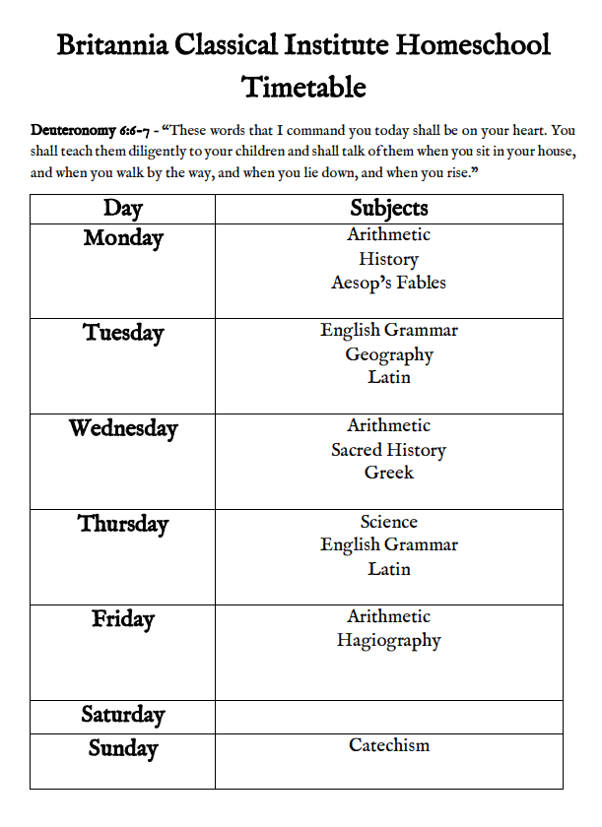
One of the simplest things we have done in our own homeschool has been to create a very straightforward weekly timetable.
It is not a timetable measured by the clock. It does not say that history begins at 9.15 or that science finishes at 10.00. Instead, it simply tells us which subjects we intend to study on each day of the week.
That small change has made a remarkable difference.
We no longer wake up each morning wondering what we ought to do. The decision has already been made. Instead of spending time planning the day, we simply begin studying.
The purpose of our timetable is not to complete an entire lesson during each session. Some lessons naturally require more time than others. A fascinating history lesson may lead to half an hour of discussion. A science lesson may inspire children to go outside and observe the natural world. A shorter grammar lesson may be completed quite quickly.
This is perfectly normal.
As we explain in our article A Lesson Takes as Long as It Takes, understanding is always more important than watching the clock.
Our timetable simply ensures that every subject receives regular attention throughout the week. Most of our subjects appear once each week, while arithmetic and English grammar appear more frequently because they benefit from regular practice. You may decide to organise your week differently, and that is one of the joys of homeschooling. The timetable exists to serve your family.
Our younger son currently follows a much simpler programme. At six years old, his studies are centred on Reading, Arithmetic, and Handwriting, together with discussions based on Aesop's Fables and Hagiography. As he grows older, we will gradually introduce additional subjects until he follows a timetable similar to that of his older brother.
There is no need to begin with everything at once.
One advantage of Britannia Classical Institute is that the online learning platform remembers exactly where each child has reached in every course. There is no need to remember page numbers, keep complicated records, or wonder which lesson comes next. Simply open the course and continue where you finished last time.
Sometimes a lesson captures our child's imagination so completely that we decide to complete a second lesson in the same subject. At other times we may stop after one lesson because we have spent so long discussing the ideas together. We never feel pressured to keep to a rigid schedule simply because a timetable says we should.
The timetable provides direction, not restriction.
For families who are just beginning to homeschool, our advice is to start modestly.
With younger children, two or three lessons each day are usually more than enough. Trying to cover every subject every day often leaves both parent and child feeling exhausted. There is no educational advantage in overwhelming young children with an excessive workload.
Instead, concentrate on establishing good habits.
Develop the habit of sitting down together.
Develop the habit of reading carefully.
Develop the habit of completing work thoughtfully.
Develop the habit of giving each lesson your full attention.
As these habits become established, children naturally develop greater concentration and stamina. Parents are often surprised to discover how much more their children can accomplish after several months of steady and consistent study. What once felt difficult gradually becomes normal.
It is also important to remember that your timetable is never permanent.
If mornings are proving difficult, try studying in the afternoon. If one subject works better on a different day, move it. If family commitments require you to swap Thursday's lessons with Friday's, simply do so. Homeschooling gives you that freedom.
Do not be afraid of a little trial and error.
Every family is different, and every family eventually discovers its own rhythm.
The important thing is not to create the perfect timetable.
The important thing is to create one that removes unnecessary decisions, gives your week a gentle structure, and allows you to focus your energy where it belongs.
Not on planning.
Not on organising.
But on sitting beside your children, opening the next lesson, and enjoying the privilege of learning together.
I B Hutchinson