Britannia Classical Institute Home Education Programme (ages 5-14)
How does the Britannia Classical Study Portal work?
Britannia Classical Home Education Programme Curriculum Overview
(Please note: Britannia Classical Institute is continually expanding, with new lessons, resources, and courses being added as the programme develops, while maintaining the high academic and Catholic standards upon which it is founded.)
Home Education Programme (Ages 5–14)
Britannia Classical Institute offers an authentic Catholic home education programme rooted in the Classical Liberal Arts tradition. Our curriculum provides children with a rich intellectual, moral, and spiritual formation through carefully selected living books, systematic instruction, and a thoroughly Catholic worldview. Drawing upon the finest educational texts of the past, we seek to cultivate wisdom, virtue, and a lifelong love of truth, goodness, and beauty.
The programme combines carefully chosen classical texts with modern online delivery, enabling parents to confidently direct their children's education while maintaining both academic rigour and the flexibility that home education affords. Every course has been carefully designed to provide clear progression, practical guidance, and comprehensive support for both pupils and parents.
A Foundation for the Classical Liberal Arts
The Home Education Programme has been carefully designed to prepare pupils for the formal study of the Seven Liberal Arts during the secondary years. Rather than viewing primary education as an end in itself, these years are understood as an essential period of intellectual formation, laying the foundations upon which later studies are built.
Throughout the programme, pupils develop secure knowledge and disciplined habits in reading, writing, mathematics, history, geography, science, and the classical languages of Latin and Greek. Above all, they receive a thorough formation in the Catholic Faith, ensuring that all learning is rightly ordered towards the knowledge and love of God. By the completion of the programme, pupils possess the knowledge, habits of study, and intellectual maturity necessary to undertake more advanced classical studies with confidence.
The Classical Liberal Arts Diploma (Ages 14–18)
Britannia Classical Institute is currently developing an RQF Level 2 and RQF Level 3 Classical Liberal Arts Diploma for students aged 14–18. The diploma is being designed to provide a rigorous and authentically classical education centred upon the Seven Liberal Arts and may be studied alongside GCSE courses or as part of a broader home education programme.
Together, the Primary Programme (Ages 5–14) and the forthcoming Classical Liberal Arts Diploma (Ages 14–18) will provide families with a complete Catholic classical educational pathway, guiding pupils from the foundational years through to university preparation and equipping them with the intellectual, moral, and spiritual formation needed for faithful Christian adulthood.
Home Education Curriculum (Ages 5–14)
At Britannia Classical Institute, we provide a rich and rigorous classical education rooted in the Catholic intellectual tradition and the finest educational practices of Britain. Our curriculum is built upon carefully selected historic textbooks that have educated generations of children and continue to offer an unsurpassed foundation in knowledge, reasoning, eloquence, and Christian virtue. Through living books, narration, memorisation, recitation, copywork, discussion, and systematic instruction, pupils develop both intellectual excellence and strength of character in an atmosphere that nurtures a lifelong love of learning.
The Fullness of a British Catholic Classical Curriculum
Aesop's Fables
Through the timeless stories of Aesop's Fables, pupils explore enduring lessons in wisdom, virtue, and moral character. Reading, narration, discussion, and copywork encourage thoughtful reflection while strengthening comprehension, vocabulary, and expressive language.
Catechism
Systematic instruction in the Catholic Faith provides pupils with a clear understanding of the Creed, Sacraments, Commandments, prayer, Christian morality, and the life of grace. Through carefully structured lessons, pupils develop a firm foundation in Catholic doctrine while cultivating Christian virtue and a lifelong love of God.
English Grammar
The first of the seven liberal arts: Grammar. Systematic instruction in English grammar, sentence structure, composition, and written expression enables pupils to write with clarity, precision, and confidence. Through carefully graded lessons, children develop a thorough understanding of the structure of the English language while applying their knowledge through narration, dictation, sentence exercises, and guided composition. The course cultivates both accuracy and eloquence, equipping pupils with the knowledge and skills to communicate clearly and effectively in both speech and writing.
Geography
Pupils study continents, countries, climates, landforms, natural resources, and the peoples of the world through engaging lessons that combine geography with history and culture. Map work, narration, and careful observation foster an understanding of the relationship between people and places, with particular attention given to Britain and the wider world.
Greek
Ancient Greek is introduced through engaging narrative readings that develop vocabulary and grammar naturally in context. Pupils build confidence in reading Greek while gaining access to the language of the New Testament and the intellectual heritage of classical civilisation.
Hagiography (Lives of the Saints)
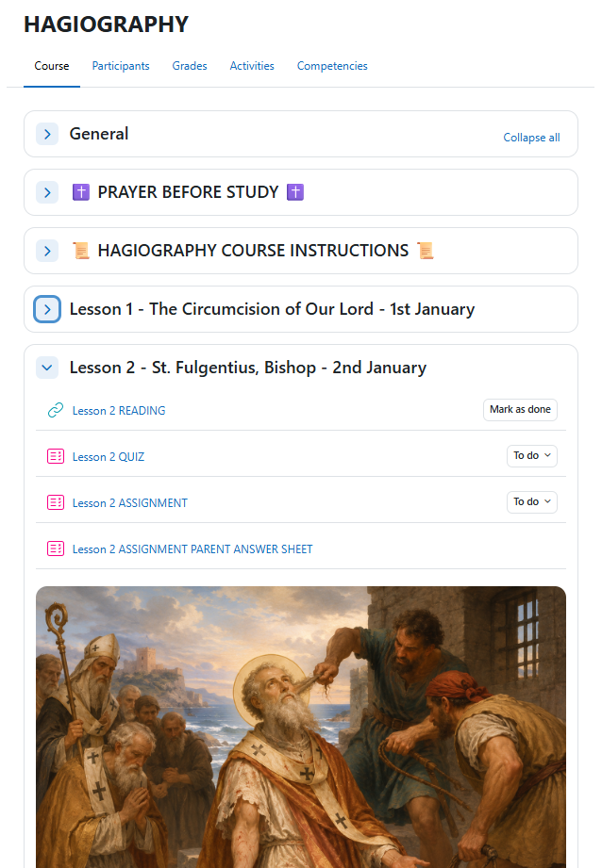
The lives of the Catholic saints introduce pupils to the men and women who faithfully followed Christ across every age of the Church. Through rich biographies, primary sources, narration, timelines, and feast-day study, pupils encounter inspiring examples of Christian virtue while gaining a chronological understanding of Church history and recognising the work of Divine Providence in the lives of the saints.
History
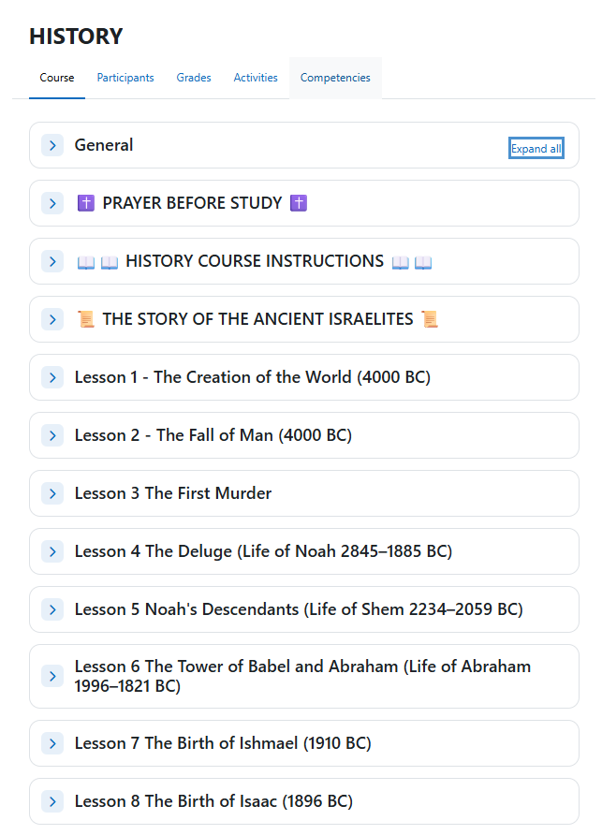
Narrative histories of the Ancient Israelites, Greeks, Romans, and English provide pupils with a chronological understanding of the rise and development of great civilisations. Through living books, narration, timelines, and map work, pupils learn to recognise the unfolding of Divine Providence in history while appreciating the cultural foundations of Western civilisation.
Latin
Latin is taught as the language of the Church and a cornerstone of classical education. Pupils learn ecclesiastical pronunciation, traditional prayers, selections from Sacred Scripture, and carefully graded Latin readings while developing vocabulary, grammar, translation skills, and an appreciation of the Church's liturgical and intellectual heritage.
Mathematics
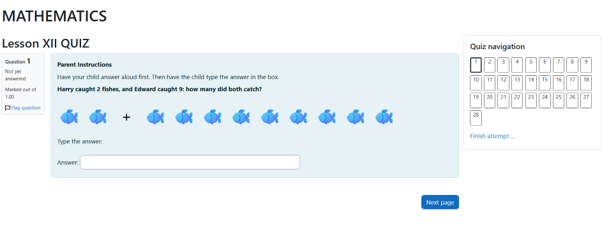
Mathematics is taught through mastery, mental calculation, logical reasoning, and systematic review. Beginning with number work and progressing through arithmetic and introductory geometry, pupils develop confidence, precision, and a deep appreciation of the order and harmony found in mathematics.
Reading
A carefully graded reading programme for younger years develops fluency, vocabulary, comprehension, and literary appreciation. Through oral reading, narration, recitation, and discussion, pupils become confident readers while encountering selections that cultivate virtue, wisdom, and a love of excellent literature.
Salvation History
Pupils study Sacred Scripture as the unfolding story of God's plan of salvation, from Creation to the founding of the Church. The course emphasises the unity of the Old and New Testaments and develops a deeper understanding of Catholic doctrine through Scripture, narration, discussion, and map work.
Science
Science is presented as the orderly study of God's creation through observation, nature study, practical experiments, and engaging lessons. Pupils explore plants, animals, the human body, weather, light, sound, electricity, astronomy, and the natural world while cultivating curiosity, logical reasoning, and wonder at the beauty of creation.
Online Learning Platform
All courses are delivered through our online learning platform, providing a structured, engaging, and intuitive learning experience for both pupils and parents. Every course has been carefully organised to provide clear progression and enable families to work confidently at their own pace.
Every course includes:
Complete lesson plans
A structured Scheme of Work
Carefully selected reading materials
Automatically marked quizzes with immediate feedback
Written assignments
Reading comprehension exercises
Application questions
Reflection questions
Progress tracking throughout the course
Parent Support
Parents are the primary educators of their children, and we are committed to supporting them throughout their home education journey. We are available to provide guidance and assistance whenever needed, ensuring that families are never without support.
Where appropriate, courses include comprehensive Parent Answer Sheets to assist with marking, discussion, and teaching, enabling parents to confidently support their child's learning at home.
Our Aim
The Britannia Classical Institute seeks to provide an authentically Catholic classical education that forms the whole person—mind, character, and soul. We strive to cultivate intellectual excellence, moral virtue, and a lifelong love of truth, goodness, and beauty, preparing pupils not only for academic success but also for faithful Christian living.
We endeavour to form young people who are:
Faithful Catholics, firmly grounded in the teachings of the Church.
Virtuous in character and committed to Christian living.
Well-read and articulate.
Skilled in reasoning, logic, and clear expression.
Competent in mathematics and scientific thinking.
Knowledgeable in history and geography.
Familiar with the classical languages of Latin and Greek.
Prepared for lifelong learning, faithful service to God, and responsible citizenship.
Course Guidance and Age Recommendations
The classical tradition has always recognised that education must respect the natural development of the child. The first-century Roman educator Quintilian, whose Institutio Oratoria became one of the most influential educational works in Western civilisation, observed:
"Most are quick to reason and ready to learn... those who are dull and unteachable are but few in number."
— Quintilian, Institutio Oratoria, I.1.1–2
At the same time, he cautioned parents and teachers against expecting mature academic work before a child is ready:
"I am not... so blind to differences of age as to think that the very young should be forced on prematurely or given real work to do."
— Quintilian, Institutio Oratoria, I.1.20
Likewise, the Catholic Church has long recognised that children gradually develop the use of reason. The Church teaches:
"A child who has completed the seventh year is presumed to have the use of reason."
— Code of Canon Law (1983), Canon 97 §2
For this reason, the Church has traditionally regarded around seven years of age as the beginning of the Age of Reason, although individual children mature at different rates.
Parents should therefore bear this in mind and avoid expecting too much too soon. Every child develops according to God's providence and at his or her own pace. Our aim is not to rush children through material, but to cultivate wisdom, virtue, sound habits, and a lifelong love of learning.
Our curriculum is rooted in the classical Catholic tradition and is designed to cultivate wisdom, virtue, and intellectual excellence. The courses have been written sequentially, with each building naturally upon previous knowledge and skills, following the approach of the best classical schools and traditional textbooks. The guiding principle throughout is not "How old is my child?" but rather, "What is my child capable of?" Children should progress according to mastery, not merely according to age.
Our introductory courses are generally suitable for children between the ages of 5 and 7. Every child develops differently, and parents should use their judgement when deciding whether their child is ready to begin. During these years, children will normally begin Reading, Handwriting, Arithmetic, Catechism 1, and Aesop's Fables, establishing the essential foundations upon which all later learning depends.
Before beginning Reading 1, children should already be familiar with the alphabet and be able to recognise and pronounce each letter correctly. Once these foundations are secure, they are ready to begin reading. Arithmetic 1, on the other hand, may be started immediately. Simply work through the course carefully and in sequence, allowing each lesson to build naturally upon the last.
For our own children, we generally begin formal handwriting between the ages of 6 and 7, depending on the individual child. We teach cursive handwriting from the beginning, and this is the style used throughout our handwriting courses. If, however, you would prefer your child to begin with print (manuscript) writing, this is perfectly acceptable. We have provided a link to a free website offering printable handwriting worksheets and fonts should you wish to begin in this manner before later transitioning to cursive.
From approximately 7–8 years of age, once children have reached the Age of Reason and have mastered the necessary foundations, they are generally ready to begin the wider curriculum. At this stage they may study English Grammar, Hagiography, History, Sacred History, Geography, Science, together with the higher courses in Catechism and Aesop's Fables. Each subject has been carefully written so that later courses build naturally upon those that come before, much as the best classical schools and textbooks have always done.
Children who are ready may also begin the study of Latin and Greek from this age. There is no need to wait until secondary school. Indeed, throughout much of history, children commonly began Latin around the age of seven or eight, with Greek following when appropriate. Naturally, a younger child will progress more slowly than an older student, and this is entirely normal. Steady, consistent progress is always preferable to hurried advancement.
Assignments throughout the curriculum have been designed to be flexible. They may be completed orally, by hand, or typed on a computer, according to your family's circumstances and your child's level of development. Some parents may prefer one method, while others may combine them depending on the subject being studied.
Remember that you are your child's primary educator. These courses are intended to support you in that noble vocation, not to replace your judgement. Feel free to adapt the assignments to suit your child whilst maintaining appropriate standards. For younger children who are still developing attention, discipline, and writing stamina, you may wish to have them write out only one answer while completing the remaining questions orally. As their confidence and endurance increase, gradually increase the amount of written work until they are able to complete all of the exercises independently.
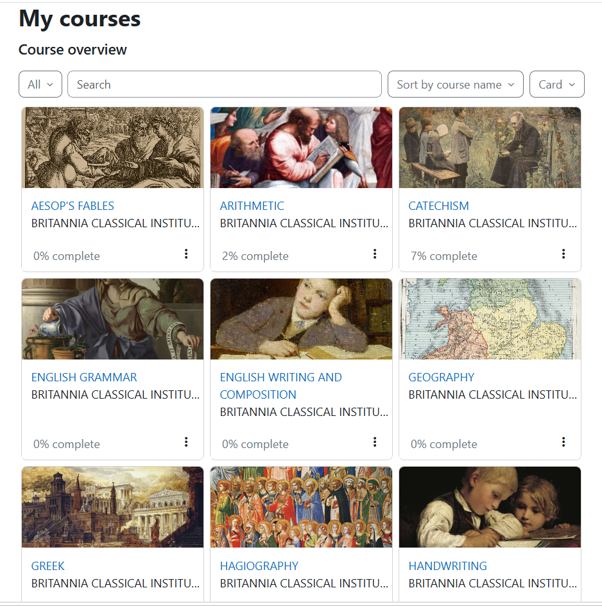
Our curriculum presently includes courses in Reading, Mathematics, English Grammar, English Writing & Composition, History, Sacred History, Geography, Science, Catechism, Hagiography, Aesop's Fables, Latin, and Greek. Together, these subjects form a coherent classical Catholic education, seeking not merely to impart knowledge, but to cultivate virtuous, articulate, and well-formed young men and women.
If you are unsure where your child should begin, or if you have any questions about placement, progression, or adapting the courses to your family's needs, please do not hesitate to contact us. We are always happy to offer guidance and support as you undertake the noble vocation of educating your children.
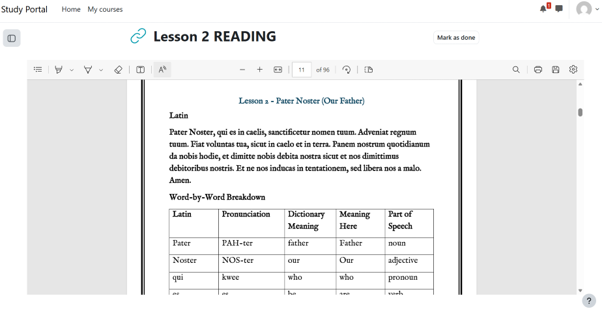
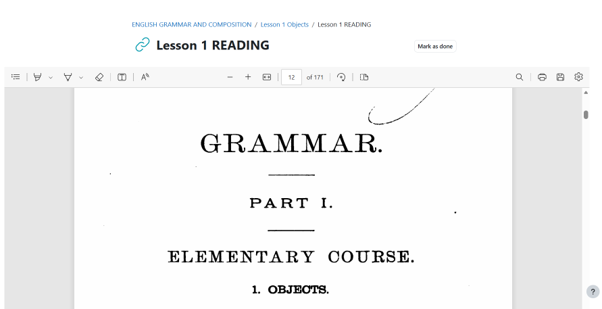
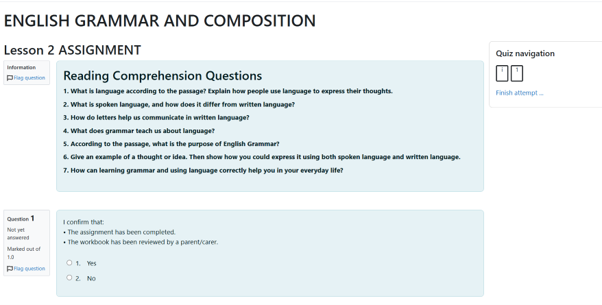
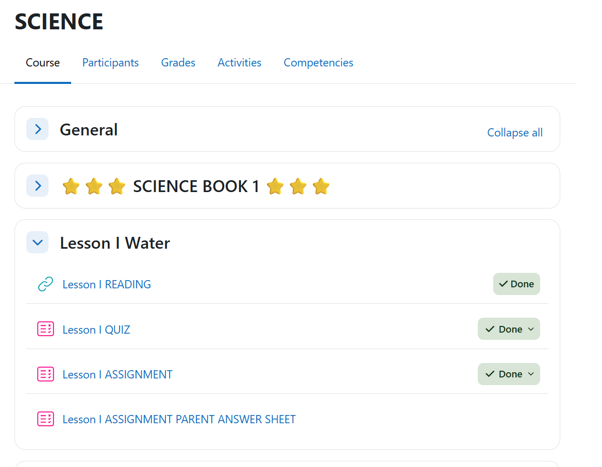
The Britannia Classical Institute is delivered through our dedicated online learning platform, bringing together the best of classical education with the convenience of modern technology. Each subject is organised into clear, structured courses containing weekly lessons, reading assignments, quizzes, written activities, and progress tracking, allowing parents and pupils to easily follow the curriculum from home. Where appropriate, assignments include Parent Answer Sheets to support marking and discussion, while automatically marked quizzes provide instant feedback and reduce administrative work. Parents remain firmly in control of their child's education, with the freedom to work at a pace that suits their family, while benefiting from a carefully planned curriculum that removes the burden of lesson planning and curriculum design.
Every Course Includes
A complete Scheme of Work
Carefully selected reading assignments
Integrated reading materials
Automatically marked quizzes
Written assignments and comprehension exercises
Reflection and application questions
Parent Answer Sheets (where appropriate)
Progress tracking throughout the course
Support from us whenever you need assistance
How does the Britannia Classical programme work?
Contact us
If you would like further information about the Britannia Classical Institute programmes, or wish to discuss how our curriculum may support your family's home education, please complete the contact form below.
We will be pleased to answer your questions and respond as soon as possible.